لوحة ساحة السجن لفنسنت فان جوخ
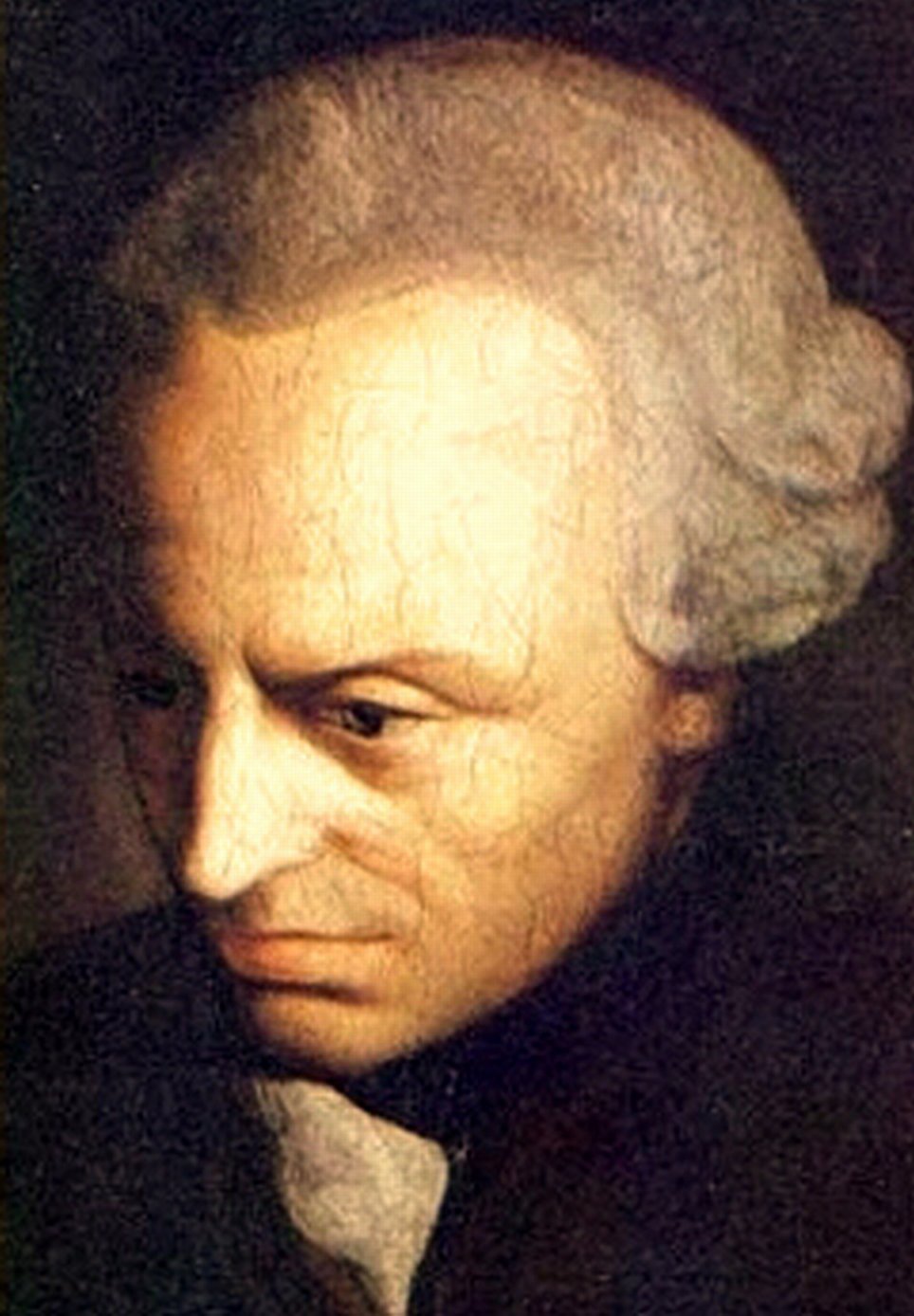
عمانوئيل كانط 1724-1804
فيلسوف بروسي (ألماني) ولد في كنجسبرج
والتحق بمعهد فريدريك الديني في العام 1732
وفي العام 1740 التحق بجامعة كنجسبيرج
حيث درس اللاتينية والأدب في المعهد
ودرس الفلسفة والرياضيات وعلوم الدين والفيزياء
وفي1755 حصل على شهادة الماجستير
وعمل مدرسا في الجامعة التي تخرج منها
بقي مدرسا مدة خمسة عشر عاما
قام خلالها بتدريس العديد من المواضيع
ومن ضمنها الميتافيزيقا والمنطق والرياضيات وعلم الأخلاق
وفشل في أن يصبح أستاذا حتى 1770
حين فرغ كرسي المنطق والميتافيزيقا وعين فيه
استمر بالعمل في الجامعة حتى 1796
اصبح عضوا في مجلس الشيوخ الأكاديمي في العام 1780
وفي 1787 صار عضوا في الأكاديمية الملكية للعلوم في برلين
توفي في عام 1804 ودفن في قبو الأساتذة في مقبرة الجامعة.
ومن ثم أقيم له ضريح في العام 1880 ونقشت على جداره
عبارته الشهيرة التي أنهى بها كتابه
"نقد العقل العملي"
"السماء المرصعة بالنجوم من فوقي والقانون الأخلاقي في باطن نفسي"

سجن البلاهة
(عمانويل كانط)
خروج الإنسان من حالة القصور التي يبقى هو المسؤول عن وجوده فيها.
والقصور هو حالة العجز عن استخدام الفكر [عند الإنسان] خارج قيادة الآخرين
والإنسان [القاصر] مسؤول عن قصوره
لأن العلة في ذلك ليست في غياب الفكر
وإنما في انعدام القدرة على اتخاذ القرار وفقدان الشجاعة على ممارسته
دون قيادة الآخرين
لتكن تلك الشجاعة على استخدام فكرك بنفسك
إن الخمول والجبن
هما السببان اللذان يفسران وجود عدد كبير من الناس
قد حررتهم الطبيعة منذ زمن بعيد
من قيادة غريبة [عنهم]لكنهم ظلوا قصّرا طوال حياتهم عن رضى منهم
حتى ليسهل على غيرهم فرض الوصاية عليهم
وما أسهل أن يبقى المرء قاصراً
فإذا كان لدي كتاب يحتل عندي مكان الفكر
وقائد يعوض الوعي فيّ
وطبيب يقرر لي برنامج تغذيتي
الخ...
فلا حاجة لي في ان أحمل نفسي عناء
[البحث]
ولا حاجة لي في أن أفكر ما دمت قادرا على دفع الثمن
لكي يقبل الآخرون على هذه المشقة المملة
إن الأغلبية الكبيرة من الناس
[بما في ذلك الجنس اللطيف إجمالا]
تعتبر تلك الخطوة نحو الرشد عظيمة الخطر
فضلا عن أنها أمر مرهق
ويساعدهم على القبول بحالة القصور هذه
أولئك الأوصياء الذين آلو على أنفسهم ممارسة سلطة لا تطال على الإنسانية
فبعد ان أطبقوا [سجن] البلاهة على قطعانهم
وعملوا على مراقبة هذه المخلوقات الهادئة مراقبة دقيقة
حتى لا تسمح لنفسها بالمجاسرة على أدنى خطوة خارج الحقل
الذي حشرت فيه
أظهروا لها الخطر الذي يهددها إن هي غامرت بالخروج وحدها
لكن الخطر ليس كبيرا في حقيقة الأمر
لأنها [لو أقدمت عليه] فسوف تتعلم السير بعد عثرات قليلة"
إلا أن مثل هذه الكبوات تولد الاحتراز
وعادة ما يحملنا الخوف- الذي ينتج عن ذلك-
على العدول عن محاولة أخرى
لذلك فإنه من العسير على أي شخص بمفرده
الإفلات من حالة القصور التي كادت أن تصبح طبيعية فيه
إذ صار يرتاح إليها-غير قادر في هذه الفترة-
على استخدام فكره الخاص وقد حرم من فرصة المحاولة
المصدر:
1-المقال كاملا
http://home.birzeit.edu/phil-cs/publications/kant.html
....Enlightenment is man's emergence from his self-imposed immaturity.Immaturity is the inability to use one's understanding without guidance from another. This immaturity is self-imposed when its cause lies not in lack of understanding, but in lack of resolve and courage to use it without guidance from another. Sapere Aude!1 "Have courage to use your own understanding!" — that is the motto of enlightenment. 
Laziness and cowardice are the reasons why so great a proportion of men, long after nature has released them from alien guidance (naturaliter maiorennes), nonetheless gladly remain in lifelong immaturity, and why it is so easy for others to establish themselves as their guardians. It is so easy to be immature. If I have a book to serve as my understanding, a pastor to serve as my conscience, a physician to determine my diet for me, and so on, I need not exert myself at all. I need not think, if only I can pay: others will readily undertake the irksome work for me. The guardians who have so benevolently taken over the supervision of men have carefully seen to it that the far greatest part of them (including the entire fair sex) regard taking the step to maturity as very dangerous, not to mention difficult. Having first made their domestic livestock dumb, and having carefully made sure that these docile creatures will not take a single step without the go-cart to which they are harnessed, these guardians then show them the danger that threatens them, should they attempt to walk alone. Now this danger is not actually so great, for after falling a few times they would in the end certainly learn to walk; but an example of this kind makes men timid and usually frightens them out of all further attempts. 
Thus, it is difficult for any individual man to work himself out of the immaturity that has all but become his nature. He has even become fond of this state and for the time being is actually incapable of using his own understanding, for no one has ever allowed him to attempt it. Rules and formulas, those mechanical aids to the rational use, or rather misuse, of his natural gifts, are the shackles of a permanent immaturity. Whoever threw them off would still make only an uncertain leap over the smallest ditch, since he is unaccustomed to this kind of free movement. Consequently, only a few have succeeded, by cultivating their own minds, in freeing themselves from immaturity and pursuing a secure course. 
But that the public should enlighten itself is more likely; indeed, if it is only allowed freedom, enlightenment is almost inevitable. For even among the entrenched guardians of the great masses a few will always think for themselves, a few who, after having themselves thrown off the yoke of immaturity, will spread the spirit of a rational appreciation for both their own worth and for each person's calling to think for himself. But it should be particularly noted that if a public that was first placed in this yoke by the guardians is suitably aroused by some of those who are altogether incapable of enlightenment, it may force the guardians themselves to remain under the yoke—so pernicious is it to instill prejudices, for they finally take revenge upon their originators, or on their descendants. Thus a public can only attain enlightenment slowly. Perhaps a revolution can overthrow autocratic despotism and profiteering or power-grabbing oppression, but it can never truly reform a manner of thinking; instead, new prejudices, just like the old ones they replace, will serve as a leash for the great unthinking mass. 
Nothing is required for this enlightenment, however, except freedom; and the freedom in question is the least harmful of all, namely, the freedom to use reason publicly in all matters. But on all sides I hear: "Do not argue!" The officer says, "Do not argue, drill!" The tax man says, "Do not argue, pay!" The pastor says, " Do not argue, believe!" (Only one ruler in the World says, "Argue as much as you want and about what you want, but obey!") In this we have examples of pervasive restrictions on freedom. But which restriction hinders enlightenment and which does not, but instead actually advances it? I reply: The public use of one's reason must always be free, and it alone can bring about enlightenment among mankind; the private use of reason may, however, often be very narrowly restricted, without otherwise hindering the progress of enlightenment. By the public use of one's own reason I understand the use that anyone as a scholarliterate world. I call the private use of reason that which a person may make in a civic post or office that has been entrusted to him. Now in many affairs conducted in the interests of a community, a certain mechanism is required by means of which some of its members must conduct themselves in an entirely passive manner so that through an artificial unanimity the government may guide them toward public ends, or at least prevent them from destroying such ends. Here one certainly must not argue, instead one must obey. However, insofar as this part of the machine also regards himself as a member of the community as a whole, or even of the world community, and as a consequence addresses the public in the role of a scholar, in the proper sense of that term, he can most certainly argue, without thereby harming the affairs for which as a passive member he is partly responsible. Thus it would be disastrous if an officer on duty who was given a command by his superior were to question the appropriateness or utility of the order. He must obey. But as a scholar he cannot be justly constrained from making comments about errors in military service, or from placing them before the public for its judgment. The citizen cannot refuse to pay the taxes imposed on him; indeed, impertinent criticism of such levies, when they should be paid by him, can be punished as a scandal (since it can lead to widespread insubordination). But the same person does not act contrary to civic duty when, as a scholar, he publicly expresses his thoughts regarding the impropriety or even injustice of such taxes. Likewise a pastor is bound to instruct his catecumens and congregation in accordance with the symbol of the church he serves, for he was appointed on that condition. But as a scholar he has complete freedom, indeed even the calling, to impart to the public all of his carefully considered and well-intentioned thoughts concerning mistaken aspects of that symbol, as well as his suggestions for the better arrangement of religious and church matters. Nothing in this can weigh on his conscience. What he teaches in consequence of his office as a servant of the church he sets out as something with regard to which he has no discretion to teach in accord with his own lights; rather, he offers it under the direction and in the name of another. He will say, "Our church teaches this or that and these are the demonstrations it uses." He thereby extracts for his congregation all practical uses from precepts to which he would not himself subscribe with complete conviction, but whose presentation he can nonetheless undertake, since it is not entirely impossible that truth lies hidden in them, and, in any case, nothing contrary to the very nature of religion is to be found in them. If he believed he could find anything of the latter sort in them, he could not in good conscience serve in hisposition; he would have to resign. Thus an appointed teacher's use of his reason for the sake of his congregation is merely private, because, however large the congregation is, this use is always only domestic; in this regard, as a priest, he is not free and cannot be such because he is acting under instructions from someone else. By contrast, the cleric— as a scholar who speaks through his writings to the public as such, i.e., the world—enjoys in this public use of reason an unrestricted freedom to use his own rational capacities and to speak his own mind. For that the (spiritual) guardians of a people should themselves be immature is an absurdity that would insure the perpetuation of absurdities. ¶ makes of reason before the entire
But would a society of pastors, perhaps a church assembly or venerable presbytery (as those among the Dutch call themselves), not be justified in binding itself by oath to a certain unalterable symbol in order to secure a constant guardianship over each of its members and through them over the people, and this for all time: I say that this is wholly impossible. Such a contract, whose intention is to preclude forever all further enlightenment of the human race, is absolutely null and void, even if it should be ratified by the supreme power, by parliaments, and by the most solemn peace treaties. One age cannot bind itself, and thus conspire, to place a succeeding one in a condition whereby it would be impossible for the later age to expand its knowledge (particularly where it is so very important), to rid itself of errors,and generally to increase its enlightenment. That would be a crime against human nature, whose essential destiny lies precisely in such progress; subsequent generations are thus completely justified in dismissing such agreements as unauthorized and criminal. The criterion of everything that can be agreed upon as a law by a people lies in this question: Can a people impose such a law on itself? Now it might be possible, in anticipation of a better state of affairs, to introduce a provisional order for a specific, short time, all the while giving all citizens, especially clergy, in their role as scholars, the freedom to comment publicly, i.e., in writing, on the present institution's shortcomings. The provisional order might last until insight into the nature of these matters had become so widespread and obvious that the combined (if not unanimous) voices of the populace could propose to the crown that it take under its protection those congregations that, in accord with their newly gained insight, had organized themselves under altered religious institutions, but without interfering with those wishing to allow matters to remain as before. However, it is absolutely forbidden that they unite into a religious organization that nobody may for the duration of a man's lifetime publicly question, for so doing would deny, render fruitless, and make detrimental to succeeding generations an era in man's progress toward improvement. A man may put off enlightenment with regard to what he ought to know, though only for a short time and for his own person; but to renounce it for himself, or, even more, for subsequent generations, is to violate and trample man's divine rights underfoot. And what a people may not decree for itself may still less be imposed on it by a monarch, for his lawgiving authority rests on his unification of the people's collective will in his own. If he only sees to it that all genuine or purported improvement is consonant with civil order, he can allow his subjects to do what they find necessary to their spiritual well-being, which is not his affair. However, he must prevent anyone from forcibly interfering with another's working as best he can to determine and promote his well-being. It detracts from his own majesty when he interferes in these matters, since the writings in which his subjects attempt to clarify their insights lend value to his conception of governance. This holds whether he acts from his own highest insight—whereby he calls upon himself the reproach, "Caesar non est supra grammaticos."2 — as well as, indeed even more, when he despoils his highest authority by supporting the spiritual despotism of some tyrants in his state over his other subjects. 
If it is now asked, "Do we presently live in an enlightened age?" the answer is, "No, but we do live in an age of enlightenment." As matters now stand, a great deal is still lacking in order for men as a whole to be, or even to put themselves into a position to be able without external guidance to apply understanding confidently to religious issues. But we do have clear indications that the way is now being opened for men to proceed freely in this direction and that the obstacles to general enlightenment—to their release from their self-imposed immaturity—are gradually diminishing. In this regard, this age is the age of enlightenment, the century of Frederick3. 
A prince who does not find it beneath him to say that he takes it to be his duty to prescribe nothing, but rather to allow men complete freedom in religious matters—who thereby renounces the arrogant title of tolerance—is himself enlightened and deserves to be praised by a grateful present and by posterity as the first, at least where the government is concerned, to release the human race from immaturity and to leave everyone free to use his own reason in all matters of conscience. Under his rule, venerable pastors, in their role as scholars and without prejudice to their official duties, may freely and openly set out for the world's scrutiny their judgments and views, even where these occasionally differ from the accepted symbol. Still greater freedom is afforded to those who are not restricted by an official post. This spirit of freedom is expanding even where it must struggle against the external obstacles of governments that misunderstand their own function. Such governments are illuminated by the example that the existence of freedom need not give cause for the least concern regarding public order and harmony in the commonwealth. If only they refrain from inventing artifices to keep themselves in it, men will gradually raise themselves from barbarism. 
I have focused on religious matters in setting out my main point concerning enlightenment, i.e., man's emergence from self-imposed immaturity, first because our rulers have no interest in assuming the role of their subjects' guardians with respect to the arts and sciences, and secondly because that form of immaturity is both the most pernicious and disgraceful of all. But the manner of thinking of a head of state who favors religious enlightenment goes even further, for he realizes that there is no danger to his legislation in allowing his subjects to use reason publicly and to set before the world their thoughts concerning better formulations of his laws, even if this involves frank criticism of legislation currently in effect. We have before us a shining example, with respect to which no monarch surpasses the one whom we honor. 
But only a ruler who is himself enlightened and has no dread of shadows, yet who likewise has a well-disciplined, numerous army to guarantee public peace, can say what no republic may dare, namely: "Argue as much as you want and about what you want, but obey!" Here as elsewhere, when things are considered in broad perspective, a strange, unexpected pattern in human affairs reveals itself, one in which almost everything is paradoxical. A greater degree of civil freedom seems advantageous to a people's spiritual freedom; yet the former established impassable boundaries for the latter; conversely, a lesser degree of civil freedom provides enough room for all fully to expand their abilities. Thus, once nature has removed the hard shell from this kernel for which she has most fondly cared, namely, the inclination to and vocation for free thinking, the kernel gradually reacts on a people's mentality (whereby they become increasingly able to act freely), and it finally even influences the principles of government, which finds that it can profit by treating men, who are now more than machines, in accord with their dignity.


